
Now Reading: Beyond the Siren’s Call: When Media Becomes the Second Battlefield
-
01
Beyond the Siren’s Call: When Media Becomes the Second Battlefield
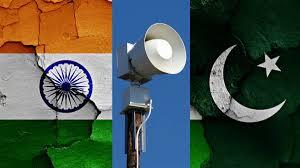

What happens when newsrooms become battlefields? When journalists transform into warriors? When viewers become casualties of information warfare? After twenty-six innocent lives were lost in Pahalgam, India’s media faced a choice: amplify trauma or heal through truth. Most chose wrong.
Pause, Rewind, Rethink, Res
The siren wails through the small living room in Jammu near Akhnoor road. Seven-year-old Aisha drops her coloured pencils and instinctively dives under the table—a practiced response to a sound that has become the soundtrack of her childhood within a week. But this time, there is no incoming shell, no approaching danger. The siren blares not from warning systems but from the family television, where a news anchor dramatically reports on Operation Sindoor with artificial sound effects engineered to maximize emotional impact.
Miles away, in a village near the Line of Control, an elderly man suffering from PTSD triggered by years of living in a conflict zone hears the same broadcast siren and collapses into memories of lost neighbors, of walls collapsing, of a lifetime punctuated by sounds designed to herald destruction. The broadcast continues, oblivious to or perhaps deliberately exploiting the psychological wounds it reopens.
This is the “unseen violence” of conflict reporting—an approach that transforms real human trauma into theatrical backdrop, all in pursuit of higher viewership and visceral engagement.
When Tragedy Becomes Entertainment
On April 22, 2025, the unthinkable happened. Twenty-six innocent tourists were brutally killed in the Pahalgam Valley of Kashmir by Pakistan-supported terrorists. Their deaths left families shattered and a nation in mourning. Days later, as collective grief still hung heavy in the air, Operation Sindur was launched at midnight on May 6, 2025—India’s military response to this horrific act of terrorism.
But between the tragedy and the response, in the delicate space where understanding should flourish, another operation was unfolding in many newsrooms across India—one arguably as destructive as any missile strike: the weaponization of journalism itself.
As Operation Sindoor intensified, we witnessed a stark divide in reporting approaches. Channel X broadcast what they termed an “exclusive” report showing “massive casualties” on the Pakistani side. The anchor, voice trembling with performative emotion, repeatedly played unverified footage while war sirens blared artificially in the studio background—the same sirens that trigger real trauma for border residents who have learned to associate that sound with imminent danger.
“Pakistan has been taught the ultimate lesson for Pahalgam,” the anchor proclaimed, as a digital counter tallied supposed enemy casualties like a macabre scoreboard—reducing human lives to statistics in a game where higher numbers meant greater “victory.”
During a primetime debate on Operation Sindoor, Network Y assembled what they called a “balanced panel.” Eight Indian commentators—primarily with military backgrounds—faced a single Pakistani journalist joining via video call. What followed wasn’t dialogue but orchestrated humiliation. The moderator interrupted the Pakistani panellist n number of times in 45 minutes while others spoke uninterrupted. When the journalist attempted to acknowledge the tragedy of Pahalgam while also discussing civilian suffering on both sides, he was labelled “the enemy’s mouthpiece” and told to “go back where you came from.”
When news becomes entertainment and reporters become performers, truth becomes the first casualty. Unverified information presented as “breaking news” creates artificial urgency. Emotional triggers—war sirens, dramatic music, graphic imagery—bypass critical thinking and activate trauma responses in viewers. The human brain, evolutionarily wired to prioritize threat detection, becomes chemically flooded with stress hormones that impair rational analysis. Complex geopolitical situations transform into simplistic “us versus them” narratives where nuance is impossible.
Repeated exposure to sensationalized conflict reporting creates measurable psychological distress in viewers comparable to mild forms of direct trauma exposure. Under such conditions, media becomes not just a messenger of conflict but an extension of it, delivering psychological impacts directly into peaceful living rooms and creating secondary trauma among those already suffering from primary trauma in border areas.
The Pause We Need
India has never lacked talented journalists. From veteran war correspondents whose bylines have illuminated conflicts across decades to emerging digital storytellers crafting nuanced narratives on YouTube channels followed by millions, our media landscape brims with skill and potential. Yet even the most capable pilots need to recalibrate their instruments when flying through storms—and the turbulence of conflict reporting demands exactly such recalibration. This is precisely when the call to pause, rewind, rethink, and reset becomes most vital. The faster the news cycle spins, the more we need to consciously slow our internal rhythms. The old lessons of verification, context, and humanity aren’t outdated — they’re the anchors that keep us moored to reality when emotions would sweep us away.
Reclaiming Humanitarian Journalism
Humanitarian journalism doesn’t mean abandoning facts or avoiding hard truths about terrorist attacks like Pahalgam—it means ensuring humanity remains visible within those truths. By revisiting the foundational principles of conflict reporting, by retrieving old lessons for new contexts, journalism serves as:
- A lifeline of accurate information for affected populations, free from psychologically harmful presentation
- A creator of hope through highlighting resilience and peace initiatives alongside conflict
- A counterbalance to propaganda from all parties involved
- A psychological safe space where events can be processed without retraumatization
- A guardian of human dignity when it’s most threatened
- A chronicle of suffering that demands accountability without exploitation
- A catalyst for peace by showing the full humanity of all involved
The best journalism doesn’t just inform—it creates spaces for empathy without sacrificing truth. During conflicts, our first duty is to the facts, but our parallel duty is to the humans within those facts. We’ve known this for decades; we simply need the courage to practice what we’ve long preached.
The Four-Step Reset
For Indian media organizations covering tensions after Pahalgam and during operations like Sindur, developing humanitarian journalism requires not innovation but restoration—a deliberate return to core principles through four essential steps:
PAUSE: Media organizations must institute mandatory “pause protocols” for crisis reporting, creating structured moments for reflection even amid breaking news. The pause isn’t dead time—it’s the most productive moment in crisis reporting when we remember to be humans first and reporters second.
REWIND: News organizations should institute regular sessions where journalists collectively revisit foundational humanitarian reporting principles and historic examples of excellent conflict coverage. Technical production guidelines should prohibit artificial war sirens and other triggering sound effects that serve no informational purpose but create real psychological harm.
RETHINK: We must reconsider what metrics define successful journalism. Not just how many watched, but what they learned, how they were moved to constructive action, and whether coverage increased understanding rather than merely outrage.
RESET: With principles revisited and structures reformed, journalism must reset its approach to conflict. Coverage must center civilian experiences rather than political narratives. Context must be prioritized over isolated incidents. Both traditional outlets and digital creators should embrace “hope journalism” that illuminates paths forward without minimizing present suffering.
The Choice Before Us
Every journalist covering the Indo-Pakistani tensions faces a fundamental choice: to be an echo chamber for hatred, amplifying the psychological warfare of conflict, or to be a voice for humanity that helps societies process trauma without retraumatization. The path chosen shapes not just media narratives but the mental health and social fabric of communities experiencing conflict. As Martin Bell, former BBC war correspondent and UNICEF Ambassador, wisely noted: “Objective journalism is a myth. Neutral journalism in the face of suffering is obscene. What we need is journalism with a moral compass—not taking political sides, but firmly on the side of civilians caught in conflicts they didn’t create.”
The truth may be the first casualty of war—but it need not remain buried if journalists commit to being its most dedicated rescue workers, even as they honour the twenty-six souls lost in Pahalgam by refusing to use their deaths as kindling for hatred’s fire or as sound bites for viewership. Beyond the siren’s call lies the true purpose of conflict journalism: not to amplify trauma but to help societies heal through understanding, compassion, and unwavering commitment to the humanity and Nationalism we all share.
Author


Advertisement
